
Plaquemines Parish Three-Day Releases
The mandatory official-source sweep found no chronological PPSO page for people released in the last 72 hours. The PPSO Corrections page is a facility and contact source. Plaquemines LAVNS is designed for a specific person. Neither offers a public three-day list that can be sorted by release date.
A valid 72-hour result must therefore come from an existing jail record for a fixed start and end time. It cannot be built by taking a current roster and treating every missing name as released. Nor can three single-day checks be joined and called complete. The live roster is a view of continued custody, while a release interval concerns custody-ending events recorded by PPSO.
Check Plaquemines Parish 72-Hour Releases
Write down the exact three-day range before contacting an agency. Include the local start date and time, local end date and time, and the fields required. The PPSO online public-record request is the documented written channel. Public Records Law allows access to existing records, but it does not require PPSO to create a custom report that its system does not maintain.
- Define the interval with start and end timestamps. State that the request concerns releases or transfers recorded during that period.
- Ask whether PPSO maintains an existing daily or interval release report. If so, request it in an available electronic form.
- List the useful fields: name, booking number, booking and release times, release type or authority, and destination or transfer.
- Use the parish LAVNS service to examine one named person when a row needs confirmation. Save the exact status and update time.
- Compare the record with the Clerk’s criminal case for bond, court order, sentence, dismissal, or commitment activity.
For a same-day question, use the Jail Releases: 24 Hours method. The three-day request is better when the target period crosses office days or when the exact day is uncertain.
Note: A precise interval helps the records custodian locate an existing report and avoids uncertainty over when a rolling “72 hours” begins.
Plaquemines Parish 72-Hour Record Fields
No verified public feed means no verified public columns exist. These requested fields come from the Plaquemines Parish release-record research and describe what an existing PPSO record may establish. The office may provide more than one source document, and parts may be withheld or redacted as law permits.
| Field | Use in a three-day review |
|---|---|
| Name and booking number | Matches each row to a distinct jail stay. |
| Booking date and time | Shows when that custody episode began. |
| Release date and time | Places the custody-ending action inside or outside the interval. |
| Release reason or type | Identifies bond, sentence completion, court action, or another recorded basis. |
| Releasing authority | Points to the court, jail, or other source behind the action. |
| Destination or transfer | Shows whether custody continued under another authority. |
A booking book is not a substitute for this field set. Under Louisiana C.Cr.P. art. 228, the booking entry covers arrival facts such as name, property taken, and booking date and time. The release entry answers when and how PPSO custody ended. Request both when the full custody sequence matters.
Plaquemines Parish Weekend Release Checks
A 72-hour span is useful around weekends and holidays because it avoids forcing one assumed release date. Bond processing, court paperwork, review of detainers, jail records entry, and the public status update may occur on different days. PPSO publishes no general weekend or holiday release schedule, so the interval should not be built around an assumed office routine.
Use event timestamps, not just a date label. A Friday order may lead to a later physical exit. A Sunday custody change may not become clear in a public system at once. When the record date and public status appear to conflict, report both and ask the source agency to explain its own entry. The physical PPSO release time and the court’s legal action answer related but distinct questions.
A person under a detainer may leave Plaquemines Parish custody without entering the community. The destination field is vital in a weekend review because another agency may accept custody while parish records show the local stay ended.
Do not infer a holiday event from the first update seen on the next office day. Keep the court-order date, physical custody-ending time, and public update time in separate columns. This preserves the sequence and prevents a later portal refresh from shifting a release into the wrong three-day interval.
Plaquemines Parish LAVNS Window Limits
Louisiana DPS&C states that LAVNS data updates every 24 hours. That statement describes an update cadence. It does not create a Plaquemines Parish 24-hour feed, a 72-hour archive, or a guarantee that a name remains visible after release. No official retention window for a released person in the parish portal was found.
The observed current roster displays name, date of birth, race, gender, arrest date, individual VINELink access, total offender count, and an update stamp. It does not display release date or type, bond, destination, unit placement, history, charges, or booking photo. A roster snapshot can help identify who remains listed at that moment. It cannot supply all releases for the prior three days.
For an older Plaquemines Parish interval, go directly to a written PPSO request and the Clerk’s case index. Live custody tools lose value as the event recedes.
Note: Record the portal access time and exact status text so a later update is not mistaken for the underlying jail-event time.
Reconcile Plaquemines Parish Release Sources
A release list row, if PPSO produces one, identifies a custody event. It does not by itself give the case outcome. “Bonded out” means the person left local physical custody subject to the case and bond terms. “Time served” addresses the custodial portion recorded, but supervision, fines, or another matter can remain. “Transferred” means custody continued elsewhere.
The Clerk’s criminal index and case docket provide the durable legal layer. Search for the matching party and case, then examine the bond order, minute entry, disposition, sentence, commitment, or later filing. Pair that legal event with the release timestamp rather than replacing one with the other. If an expungement has removed a covered record from public access, a missing search result remains inconclusive.
Identity checks matter more in a multi-day list because several bookings may involve similar names. Use a booking number or case number where possible, and compare the date of birth only when it is lawfully displayed. Never merge rows solely because a name matches. Keep each custody episode and case number distinct.
The Plaquemines Parish released inmates search explains the wider named-person path when the goal is one person rather than a complete three-day interval.
Parish Release or Other Custody
PPSO can house local detainees and people committed to Louisiana DPS&C custody. A state-sentenced person physically held in Davant may remain in state legal custody, so a parish-location change does not prove state discharge. Search the official DPS&C inmate-information route when the booking or destination points to a state sentence.
Federal and immigration transfers require their own systems. BOP covers federal prison custody, and ICE uses its detainee locator for immigration custody. Those systems do not supply a Plaquemines Parish release log. First obtain the PPSO destination or transfer record, then use the named receiving authority. This order prevents a local custody ending from being mislabeled as return to the community.
Probation and parole create another post-custody trail. A person can leave confinement and still remain under Louisiana DPS&C supervision through the Jefferson District. The assigned office or supervision label helps explain why a state locator remains active after physical release. Full discharge is different because it ends the stated correctional supervision status.
When a 72-hour PPSO report and a state record overlap, preserve both agency identifiers. One can describe the end of parish physical custody while the other describes the state sentence or supervision that continues.
Plaquemines Parish Feed Evidence
The official PPSO Corrections capture documents facility information and contact routes rather than a 72-hour release table. It is useful evidence of what the public page provides and what it does not provide.
The PPSO Corrections source is shown below.
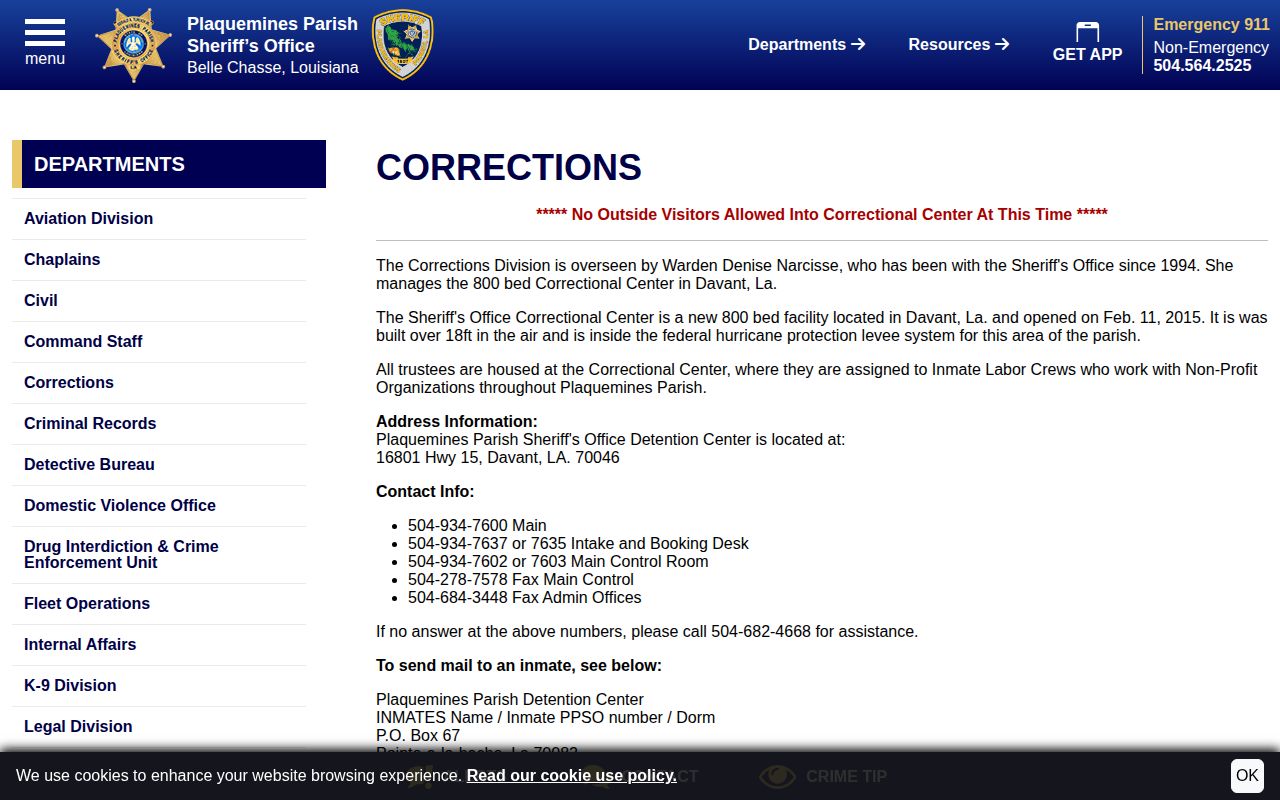
The page supports direct booking contacts and facility facts, but it does not support claims of a rolling three-day release feed.