
Plaquemines Projected and Actual Release
A projected date looks forward. It reflects the sentence and the information available when the agency computes it. An actual release date looks back at the event that ended one agency’s physical custody. The two dates may match, but they answer different questions. Louisiana DPS&C’s Bench Book uses the phrase “Projected Good Time Possible Release Date” for a post-2024 computation. That careful label signals that the date can move and that eligibility rules still matter.
A person held before trial has no fixed sentence-release date. Bond, a court order, dismissal, disposition, or another lawful event controls the local case. A person serving a parish sentence may have jail credit and a set term, but PPSO’s release entry and the 25th JDC sentence must be read together. A DPS&C-sentenced person housed at the Plaquemines Parish center remains in state legal custody, so a physical move to another facility is not a community release.
- Projected date
- A current estimate based on sentence data, credits, eligibility, and holds.
- Actual release
- The recorded time physical custody ended for the named agency.
- Transfer
- Movement to another authority or facility while custody continues.
- Discharge
- The formal end of the applicable custody or supervision term.
Find Plaquemines Projected Release Dates
Start by classifying the sentence. PPSO can hold local pretrial detainees, locally sentenced people, and people committed to DPS&C custody. One address does not make their release calculations the same. Gather full name, birth date, booking or case number, DPS&C number, sentencing court, and an approximate custody date before searching.
- For a state sentence, open the DPS&C Inmates & Families page and follow its official LAVNS locator route. Search by the strongest identifier available.
- Copy the exact status, facility assignment, location, and date label. Do not paraphrase “possible” or “projected” as “will be released.”
- Call the DPS&C automated locator at 225-383-4580 with the DPS&C number, or the name and birth date. The agency says it can return a projected release date when applicable.
- If a newly sentenced state record has no date, verify whether DPS&C received the court’s official paperwork and completed time computation.
- For a parish sentence or local pretrial case, ask PPSO Intake and Booking what record identifies the status, then inspect the 25th JDC sentence, bond order, or minute entry.
- After the event, obtain the PPSO or DPS&C release record. Compare its actual date, type, authority, and destination with the prior projection.
The Plaquemines Parish release search covers the full named-person path and the fields to request when an exact physical release event is needed. It also distinguishes a release to the community from a transfer or detainer.
Note: A blank locator field can mean computation is incomplete, not that a person has no sentence or has been discharged.
Plaquemines DPS&C Date Computation
DPS&C says it cannot calculate a newly sentenced person’s date until it receives the official sentencing papers. Those documents establish the sentence, offense information, jail credit, and whether terms run at the same time or one after another. Once computation is complete, the automated locator may provide the projected date. Time-computation information is available at 225-342-0799.
The official DPS&C FAQ shown below explains the state calculation workflow and why sentencing-paperwork delays matter. Review the DPS&C frequently asked questions before treating a missing or disputed date as final.
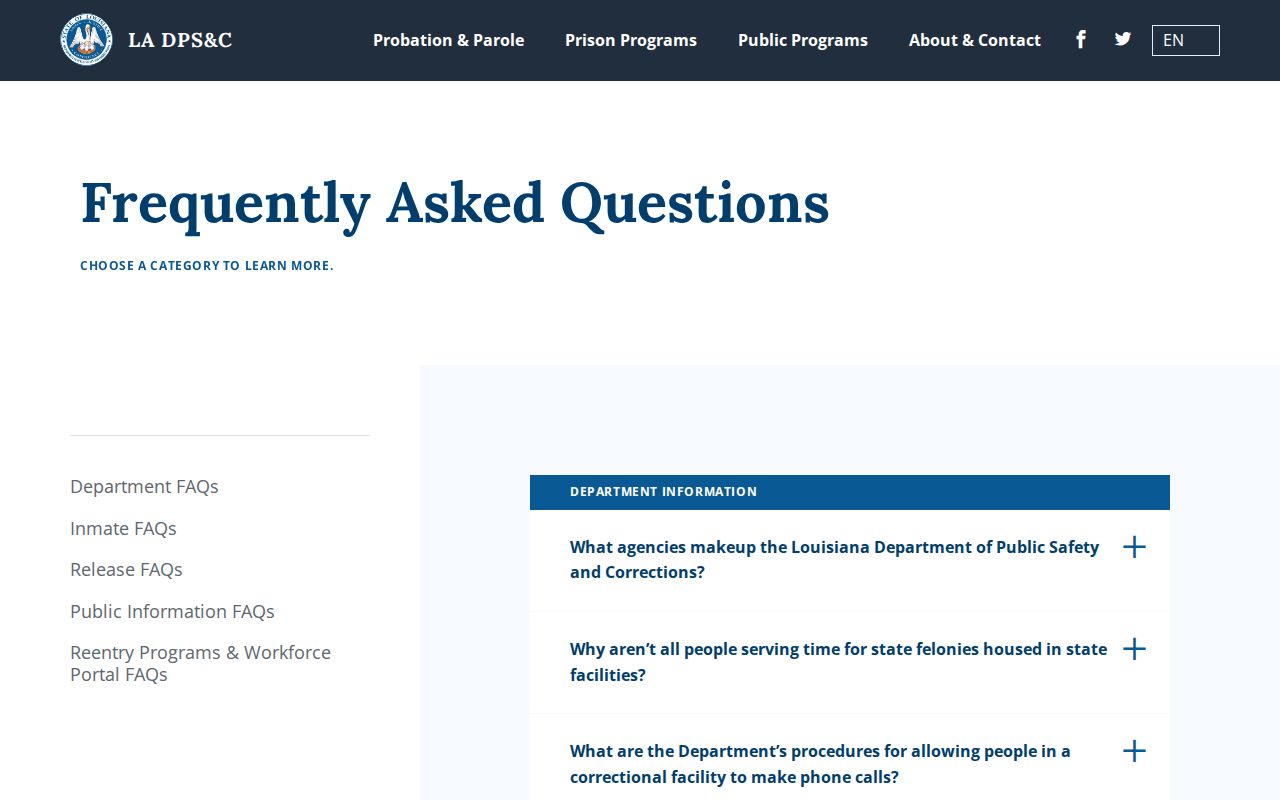
The screenshot supports the state route for a DPS&C sentence. It does not turn the same formula into a date for a Plaquemines Parish pretrial detainee.
If the imprisoned person disputes the computation, DPS&C’s FAQ describes an administrative remedy that begins with a written request to the warden or time-computation staff and relevant documents. The current agency instructions control. A caller should not try to recalculate the term from a brief docket summary when the official record may contain credits, amendments, or multiple sentences.
Plaquemines Good-Time Release Rules
Louisiana’s current framework depends on the offense date and sentence class. For an offense committed on or after August 1, 2024, R.S. 15:571.3.1 says an eligible felony offender in a parish prison or DPS&C custody may earn good-time diminution for good behavior up to 15 percent of the imposed sentence. Diminution means a lawful reduction in time based on the governing rule. The statute excludes a person convicted of a statutory sex offense and a person sentenced as a habitual offender from this ordinary category.
The 15 percent maximum produces the often cited 85 percent arithmetic, but it is not a universal release promise. Older offense dates fall under other provisions. Violent, sex, repeat, juvenile, life, and other classes can have different eligibility rules. Jail credit, consecutive terms, and court corrections also affect the computation. Read the judgment and the current statute that applies to the offense date.
Parole eligibility is another calculation, not a synonym for the good-time date. Louisiana R.S. 15:574.4 contains general eligibility provisions as well as exclusions and special classes. The offense date, conviction history, age, sentence, and exact subsection can matter. The Board’s hearing schedule shows when an eligible matter may be considered, while its later result shows the panel action. Neither source replaces DPS&C’s computed date or the custody agency’s actual release entry.
The manifest image below comes from the official good-time statute. Its source text is the proper starting point for the post-2024 Plaquemines Parish projected release computation.
Open Louisiana R.S. 15:571.3.1.
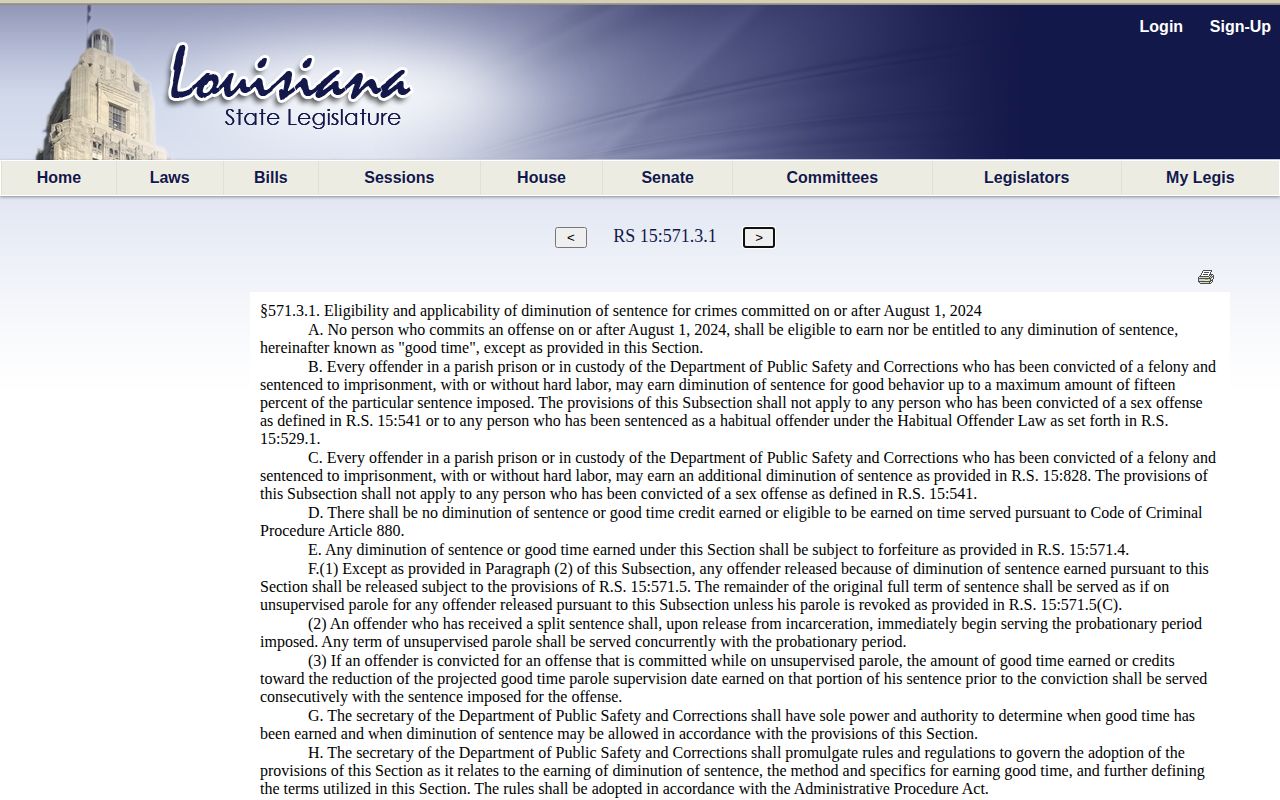
The statute image reinforces that eligibility and exclusions must be checked before the percentage is applied to a sentence.
Why Plaquemines Cannot Assume 85%
The Plaquemines-specific error to avoid is using an 85 percent shorthand for every person at the Detention Center. The post-August 2024 rule covers eligible felony sentences in parish or state custody, but it expressly excludes the listed sex-offense and habitual-offender categories. A local pretrial booking has no imposed prison term to reduce. Its timing depends on a bond event, court order, or other case action.
A locally housed person can also be in DPS&C legal custody. In that setting, the state computation follows the person even though the bed is in a parish facility. Conversely, a local misdemeanor sentence requires the actual judgment and PPSO custody record. Facility location is therefore not a safe substitute for sentence type.
Good-time release may still leave a legal status. R.S. 15:571.5 describes release through diminution as release as if on parole and addresses a certificate, conditions, and the remaining full term. Physical exit does not always mean full discharge.
A Plaquemines Parish records check should also preserve the date of each source. DPS&C states that LAVNS updates every 24 hours, so the database view may follow the underlying event. The update interval is not a promise that a projected date will remain unchanged for a full day, nor does it create a daily release list. When an old screenshot and a later agency response differ, the access times help show which record was current at each stage.
Plaquemines Release Dates Can Change
A projected date is only as sound as the current sentence and custody data. Several official actions can move it earlier or later. Some correct the underlying sentence. Others change credit or block the planned exit. Record the date the projection was accessed so a later change can be explained without treating the older display as false.
| Factor | Possible effect | Source to check |
|---|---|---|
| Corrected jail credit | Changes time already counted toward the term | DPS&C computation and sentencing record |
| Amended or vacated sentence | Changes the lawful term or removes it | 25th JDC order and DPS&C update |
| Concurrent or consecutive clarification | Changes whether terms overlap | Judgment and time-computation record |
| Earned or lost credit | Moves the good-time projection | DPS&C or facility credit record |
| Parole action | May create, deny, delay, or change a release path | Board docket, result, and DPS&C status |
| Detainer or new case | May cause transfer or continued custody | Releasing agency, receiving authority, and court |
| Data lag | Leaves an old date visible after the source event changed | Originating agency and access timestamp |
A Board result marked “Granted” does not certify a same-day exit. An approved plan, conditions, paperwork, or detainer can intervene. Likewise, a court order can precede jail processing. Preserve both the legal-action time and the physical-release time.
Note: Report a date as projected until an official custody event confirms that release occurred.
Confirm Plaquemines Actual Release Dates
Use LAVNS for a custody-change lead, then verify the event with the agency that held the person. The Plaquemines parish portal covers a named local record. The state route covers DPS&C custody and may continue to show probation or parole after prison. A release alert can lag. It also may omit the legal reason or destination.
The Plaquemines VINELink inmate search explains how to register for a specific-person alert and why the state Victim Outreach program is separate. For an exact PPSO event, request the existing booking sheet, jail-management release entry, release authorization, date and time, type, authority, and destination. For state custody, ask DPS&C for the existing release or discharge record tied to the DPS&C number.
A state victim notice and a local LAVNS registration are not the same service. A person eligible for Louisiana DPS&C Victim Outreach notices should follow that program’s separate registration process for the listed state-custody events, including projected or actual physical release notices. LAVNS remains useful for the named-person status check. Neither channel is a substitute for the record created by the jail or department when the event occurs.
Finally, compare the custodial event with the 25th JDC or other sentencing court record. The court explains why release was lawful. The jail or corrections department records when its custody ended. If another authority received the person, describe the result as a transfer until that authority’s status is checked.